01 | Factory Competitiveness Is Shifting from Equipment to Data
High-end equipment manufacturing is a critical part of the industrial system.
As new energy, power equipment, and major infrastructure projects continue to grow, manufacturers need more than higher production efficiency. They also need greater product consistency, faster delivery, and more precise operational management.
Traditional factories rely on experience-driven management, standalone automation, and manual coordination. These models are increasingly unable to meet the demands of modern manufacturing.
The factory of the future will not compete on equipment alone. It will depend on how effectively equipment, data, and management work together.
Digitalization is redefining high-end equipment manufacturing.
02 | When a Traditional Workshop Meets a New Manufacturing Challenge
As a major manufacturer in China's power generation equipment industry, Harbin Electric Group undertakes the production of a wide range of high-end equipment.
Punching and shearing is a critical stage in the production of core components. It also has a direct impact on production efficiency and product quality.
As production volumes increased, the traditional workshop faced several challenges:
Limited Automation
Punching, loading and unloading, and material handling relied heavily on manual coordination, limiting production cycles and capacity.
Siloed Data
Robots, equipment, MES, and warehouse systems operated independently. Production data was difficult to share, limiting visibility across the operation.
Manual Quality Inspection
Critical quality checks relied largely on manual sampling, making it difficult to identify issues early or achieve end-to-end traceability.
Experience-Driven Management
Equipment status, production progress, and inventory movements were distributed across different systems, limiting the efficiency of scheduling and maintenance decisions.
03 | A Smart Factory Is More Than Automation. It Is End-to-End Coordination.
A smart factory is not simply about adding more robots.
True intelligence comes from bringing production equipment, processes, operations, and data systems together as one coordinated system.
With this goal, QKM and its partners developed an integrated solution spanning automated production lines, the Industrial Internet, and a digital twin platform.
Robots execute. Data connects. Platforms enable decisions.
A workshop once driven by experience is evolving toward a new model of data-driven, autonomous coordination.
04 | From Automated Production Lines to Digital Twins, a Factory Transformed
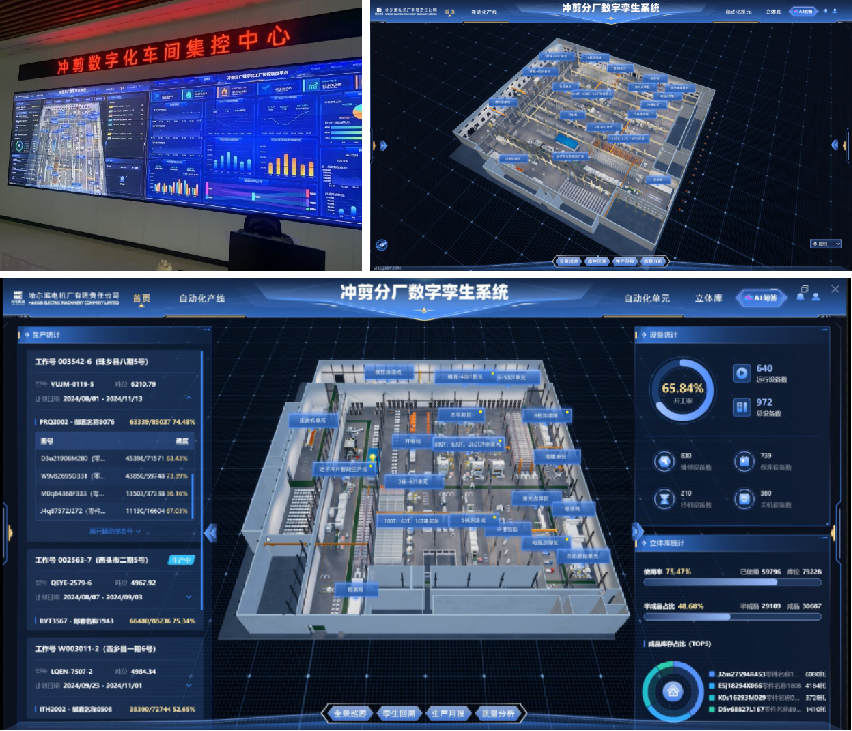
To support the smart factory transformation, QKM partnered with Inspur to build an integrated smart punching and shearing factory for Harbin Electric Group, covering production, management, and operations.
Core Capabilities
Fully Automated Production
Built a fully automated 630-ton punching line and upgraded the 400- to 800-ton production presses, enabling automated loading and unloading, material handling, and cross-process coordination.
Intelligent In-Line Quality Management
Vision inspection systems monitor key quality indicators, including burrs, missing material, coating thickness, and weld points, enabling automated quality control throughout the process.
Digital Twin Operations Platform
MES, WMS, equipment management, and robot control systems are integrated to unify data collection across equipment, production, warehousing, and quality, creating a digital twin of the workshop.
AI-Assisted Decision-Making
AI algorithms support predictive maintenance, process parameter optimization, quality prediction, and intelligent knowledge retrieval—shifting management from experience-driven to data-driven decision-making.
Customer Value
By integrating automation and digitalization, the punching and shearing factory has upgraded production efficiency, product quality, equipment management, and operational processes—establishing a new model for smart manufacturing in power equipment production.
Higher Production Efficiency
Automated production lines now cover key processes including punching, coating, and inspection. Production efficiency increased by 30%, with annual output value also increasing by 30%, supporting high-cycle, continuous production.
Smarter Quality Management
In-line vision inspection combined with AI quality prediction delivers over 90% accuracy in quality prediction. Product defects can be traced throughout the process, helping reduce the risk of batch defects and ensure reliable delivery of critical components.
More Efficient Equipment Management
The digital twin platform provides 100% digital mapping of the workshop and real-time equipment monitoring. AI-powered predictive maintenance helps reduce unplanned downtime, improve Overall Equipment Effectiveness (OEE), and support continuous production.
A Replicable Smart Factory Model
The project integrates automated production lines with an industrial digital platform, capturing expertise in equipment maintenance, process optimization, and production management. It provides a scalable model for Harbin Electric Group’s future digital transformation and a practical reference for smart factory development across high-end equipment manufacturing.